Mosquito pressure across Harris County remains an extended ten-month seasonal challenge rather than a brief summer inconvenience. The confluence of heavy subtropical rainfall, flat topography, and slow-draining gumbo…
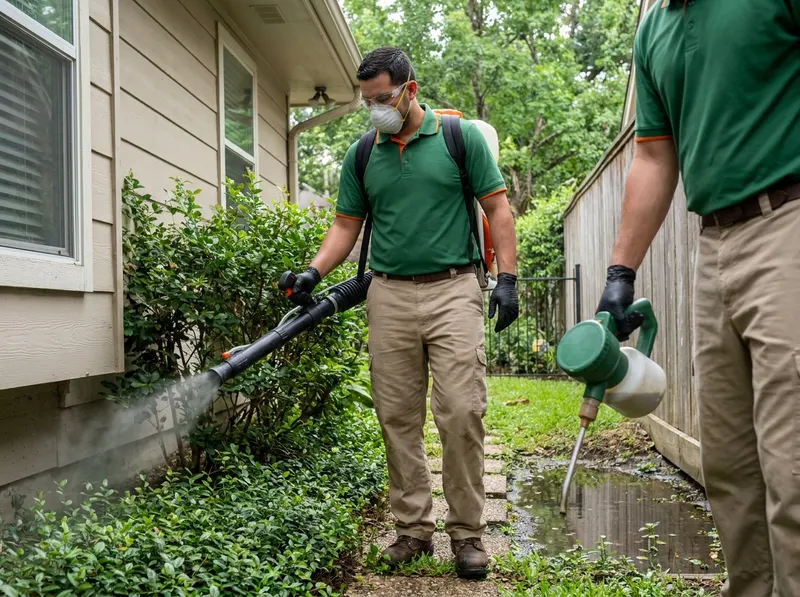
Mosquito pressure across Harris County remains an extended ten-month seasonal challenge rather than a brief summer inconvenience. The confluence of heavy subtropical rainfall, flat topography, and slow-draining gumbo clay produces continuous surface stagnation. Effective relief requires addressing the biological requirements of primary local vectors, including the daytime-biting Aedes aegypti and the dusk-active southern house mosquito. Routine over-the-counter automated aerosol misting kits and hand-held broad-spectrum sprays degrade rapidly under intense solar radiation and rainfall wash-off. Professional dual-stage management applies micro-encapsulated water-based suspensions to the undersides of dense foliage where adult insects seek shelter from daytime thermal stress, alongside systemic microbial larvicides deposited directly into stagnant moisture catchments.
Properties located in established tree-lined parcels throughout Memorial, The Heights, and River Oaks feature mature live oaks, dense azalea beds, and heavy canopy coverage that harbor high populations of resting adult insects. Conversely, communities characterized by sustained bayou humidity and shallow surface drainage, such as Meyerland along Brays Bayou, Oak Forest, or Clear Lake City near coastal inlets, present elevated water collection challenges. Ground applications must strictly avoid active blooming flowers and vegetable plots to prevent harm to beneficial insect species, following guidance established by the EPA Pollinator Protection framework. Technicians evaluate every yard perimeter to establish precise boundary treatments, targeting dense ornamental ground cover, ivy, and shaded fence lines where humidity levels exceed 75 percent during peak daylight hours.
Water-retaining receptacles represent the second critical vector phase. Subterranean catch basins, French drains, corrugated gutter downspout extensions, and low swales frequently retain standing liquid even during dry spells. Instead of spraying chemical insect neurotoxins into municipal drainage systems, ArborCrest Pest Control incorporates biological control agents regulated under EPA Bti guidelines. Formulations of Bacillus thuringiensis israelensis release target-specific proteins that destroy larval stomach linings within 24 hours of ingestion, without creating residual toxicity for domestic animals, birds, or native aquatic amphibians. This targeted ecological methodology satisfies municipal drainage run-off criteria set forth by the Texas Commission on Environmental Quality while protecting domestic living environments.
1. Initial physical inspection: The technician surveys property boundaries, mapping non-target pollinator habitats, assessing drainage paths, and cataloging ornamental leaf canopy coverage.
2. Water source remediation: All non-removable stagnant water features, sump collection points, and low-lying swales receive solid-form biological larvicide rings or slow-dissolve granules conforming to vector control standards.
3. Foliar perimeter misting: High-pressure motorized backpack foggers disperse microscopic chemical micro-droplets calibrated to adhere to the underside surfaces of foliage along perimeter fence borders, shrubs, and exterior structural perimeters up to a height of 10 feet.
4. Post-application dry cycle: Treated surfaces bond with leaf cuticles and dry completely within 30 minutes, allowing pets and family members to safely re-enter the lawn space without transfer risks.
The operational trade-off between standalone adulticide barrier fogging and integrated larvicide placement centers on residual longevity versus initial speed. Mist applications yield immediate mechanical knock-down within an hour of treatment, yet adult populations inevitably rebound within 10 days if nearby subterranean water reservoirs remain unaddressed. Combining foliar residual barriers with water-table biological larvicide provides stable month-long perimeter suppression, insulating open patio spaces, exterior cooking areas, and play lawns from relentless Gulf Coast swarms.
Every job gets a firm, written price after a free on-site visit.
For standards, safe disposal, and service guidance on pest control services in Houston, TX, useful references include U.S. EPA, ENERGY STAR, U.S. Dept. of Energy, Consumer.gov, U.S. Census Bureau, and Google Maps. General consumer and small-business resources are available from USA.gov, Better Business Bureau, FTC Consumer Advice, U.S. Small Business Administration, and Ready.gov.
Tell us about your perimeter mosquito fogging and larvicide job in Houston and we'll send a clear, written quote, usually the same day.
 ArborCrest Pest Control