Outdoor parasite control across Southeast Texas requires an understanding of localized soil hydrology and humidity cycles. In neighborhoods such as Oak Forest, The Heights, and Montrose, deep lot canopies and dense…
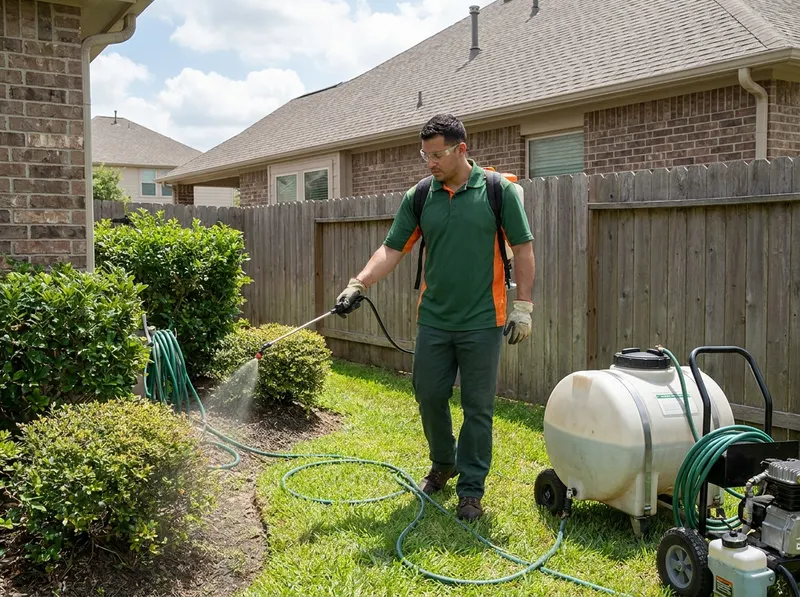
Outdoor parasite control across Southeast Texas requires an understanding of localized soil hydrology and humidity cycles. In neighborhoods such as Oak Forest, The Heights, and Montrose, deep lot canopies and dense ground covers provide ideal microclimates for the cat flea life cycle. When relative humidity remains elevated, flea pupae emerge rapidly from organic soil matter under decks and low-hanging vegetation. Traditional retail hose-end sprayers rinse away rapidly in heavy Gulf Coast downpours, dispersing water-soluble active ingredients into storm drains rather than binding to thatch layers. ArborCrest Pest Control applies microencapsulated formulations and granular formulations that adhere directly to organic debris, remaining lethal to biting instars through recurring rainfall cycles.
Tick populations present distinct migration patterns across sprawling, heavily wooded corridors such as Memorial, Kingwood, and River Oaks. Shaded perimeter ecotones where manicured St. Augustine turf meets undisturbed brush harbor high densities of the lone star tick and Gulf Coast tick. Research from Texas A&M AgriLife Extension highlights that ambient soil moisture determines larval survival rates in Harris County backyards. Flea and tick yard remediation targets these specific harbourage zones rather than broadcasting excessive chemicals across open, sunny turf where surface temperatures naturally suppress pest survival. Homeowners avoid indiscriminate chemical exposure while establishing an impenetrable perimeter that prevents hitchhiking parasites from crossing interior thresholds.
In suburban layouts across Meyerland, West University Place, and Clear Lake City, dense neighborhood fencing and localized urban wildlife transport ongoing pest waves. Feral cats, opossums, and raccoons act as continuous transport hosts, shedding flea eggs into shaded mulch beds along foundation footings. Standards detailed by the Centers for Disease Control and Prevention indicate that suppressing environmental vector densities directly lowers domestic exposure to vector-borne pathogens. Treatment protocols utilize precise dosing under guidelines maintained by the Environmental Protection Agency, incorporating juvenile hormone mimics validated by the Entomological Society of America to inhibit the transition of flea larvae into reproductive adults.
Effective yard remediation operates through an orderly four-step sequence. First, technicians survey shaded soil voids, pet bedding zones, and deck crawlspaces to record baseline thermal and moisture levels. Second, targeted granular insect growth regulators are distributed through organic mulch beds and shaded leaf litter. Third, a low-pressure liquid perimeter treatment is applied along fence lines, foundation perimeters, and patio transitions to create a residual active barrier. Fourth, homeowners receive physical mitigation guidance, addressing St. Augustine thatch depth and low-hanging tree branches to maximize sunlight penetration. Surface guidance from the USDA Animal and Plant Health Inspection Service and pet-safety standards from the American Veterinary Medical Association support limiting chemical treatments to verified pest harborage zones, maintaining low-impact domestic safety while providing total property relief. For questions, call (281) 270-1643.
Every job gets a firm, written price after a free on-site visit.
For standards, safe disposal, and service guidance on pest control services in Houston, TX, useful references include U.S. EPA, ENERGY STAR, U.S. Dept. of Energy, Consumer.gov, U.S. Census Bureau, and Google Maps. General consumer and small-business resources are available from USA.gov, Better Business Bureau, FTC Consumer Advice, U.S. Small Business Administration, and Ready.gov.
Tell us about your fleas and tick yard remediation job in Houston and we'll send a clear, written quote, usually the same day.
 ArborCrest Pest Control