Managing the red imported fire ant ( Solenopsis invicta ) across the Gulf Coast demands biological precision rather than indiscriminate pesticide applications. Houston’s high annual rainfall exceeding 50 inches and…
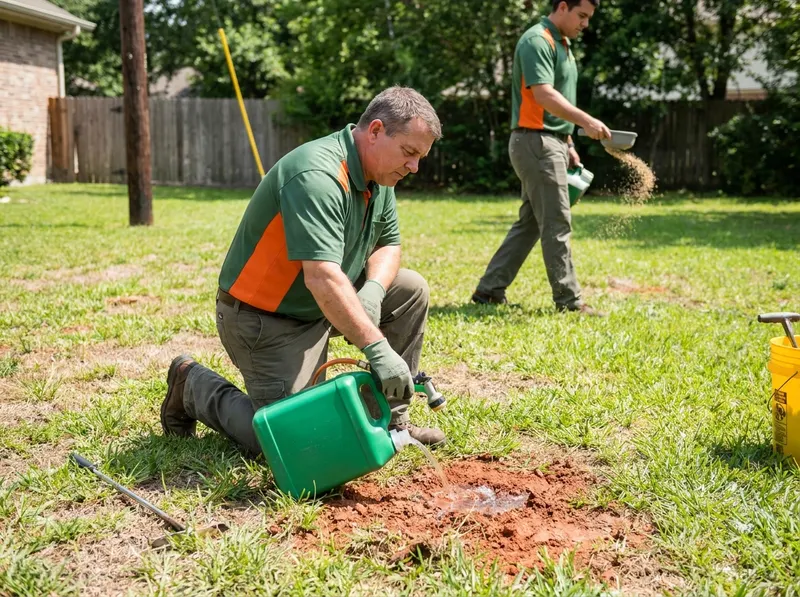
Managing the red imported fire ant (Solenopsis invicta) across the Gulf Coast demands biological precision rather than indiscriminate pesticide applications. Houston’s high annual rainfall exceeding 50 inches and poorly draining Beaumont clay soils create ideal nesting dynamics along sidewalk interfaces, foundation perimeters, and sod root zones. In established neighborhoods such as West University Place, River Oaks, and Memorial, expansive shade canopies and automated irrigation systems draw colonies upward into turf surfaces. When lawn perimeters interface with waterways like Buffalo Bayou Park or Brays Bayou in Meyerland, colony expansion surges following seasonal floods via floating ant clusters. Standard contact aerosols from retail hardware stores routinely cause colony budding, prompting single colonies to divide into multiple satellite queens throughout the property. ArborCrest Pest Control implements the proven two-step strategy validated by the Purdue University Extension Entomology protocol: broadcasting non-repellent, micro-encapsulated growth inhibitors across the turf, complemented by precision root-zone saturation on visible nest structures.
Individual mound drenching is deployed exclusively on visible, high-traffic mounds situated near family patios, driveways, play structures, and landscaping edges. Using calibrated application equipment that follows guidelines set by the United States Environmental Protection Agency, technicians apply 1 to 2 gallons of liquid formulation directly into the apex of each nest. This volume penetrates 10 to 14 inches downward to contact the queens directly, avoiding foul chemical odors and preventing airborne drift. This localized liquidation provides immediate relief within 4 to 24 hours. However, drenching visible mounds alone resolves only roughly 20% of the local population, as unseen subterranean foraging networks remain fully operational under turf thatch. Pairing drenching with broadcast distribution addresses this biological limitation.
Broadcast yard baiting utilizes specialized rotary spreaders calibrated to distribute 1.0 to 1.5 pounds of insect growth regulator (IGR) bait per acre, adhering to safety metrics established by the Texas A&M AgriLife Extension fire ant research initiative. Field technicians monitor regional soil moisture and temperature profiles, applying bait only when soil surface temperatures rest between 70°F and 90°F. During these windows, sterile worker ants actively forage, gathering the corn-grit carrier saturated with active ingredients like hydramethylnon or pyriproxyfen and transporting it directly to the reproductive queen. In residential tracts throughout Kingwood, Oak Forest, and The Heights, this method neutralizes the reproductive cycle without leaving toxic surface residues on grass blades, conforming to residential health standards outlined by the Centers for Disease Control and Prevention. Baits are withheld if precipitation is anticipated within 8 hours, preventing hydrolysis and product degradation as governed by pesticide storage and application codes from the Texas Department of Agriculture.
Suburban lots in Clear Lake City and Montrose with established multi-queen networks require tailored application schedules. Single-family homes adjoining urban greenways such as Hermann Park or Memorial Park face continuous re-invasion pressure from unmanaged public easements. The application process requires zero automated auto-pay commitments, allowing homeowners to select seasonal treatments timed to active foraging cycles in late spring and early autumn. Technical inspections document electrical utility boxes, air conditioning condenser pads, and water meter vaults where foraging workers seek dry cavities, following electrical safety precautions consistent with the Occupational Safety and Health Administration guidelines. All application metrics are logged according to standards overseen by the ASTM International environmental property evaluation practices and ecological turf standards endorsed by the Soil Science Society of America.
Every job gets a firm, written price after a free on-site visit.
For standards, safe disposal, and service guidance on pest control services in Houston, TX, useful references include U.S. EPA, ENERGY STAR, U.S. Dept. of Energy, Consumer.gov, U.S. Census Bureau, and Google Maps. General consumer and small-business resources are available from USA.gov, Better Business Bureau, FTC Consumer Advice, U.S. Small Business Administration, and Ready.gov.
Tell us about your fire ant mound drenching and yard baiting job in Houston and we'll send a clear, written quote, usually the same day.
 ArborCrest Pest Control