Gulf Coast humidity and mature tree canopies in established neighborhoods like Memorial, River Oaks, and The Heights create direct aerial pathways for roof rats to access vulnerable fascia boards, ridge vents, and…
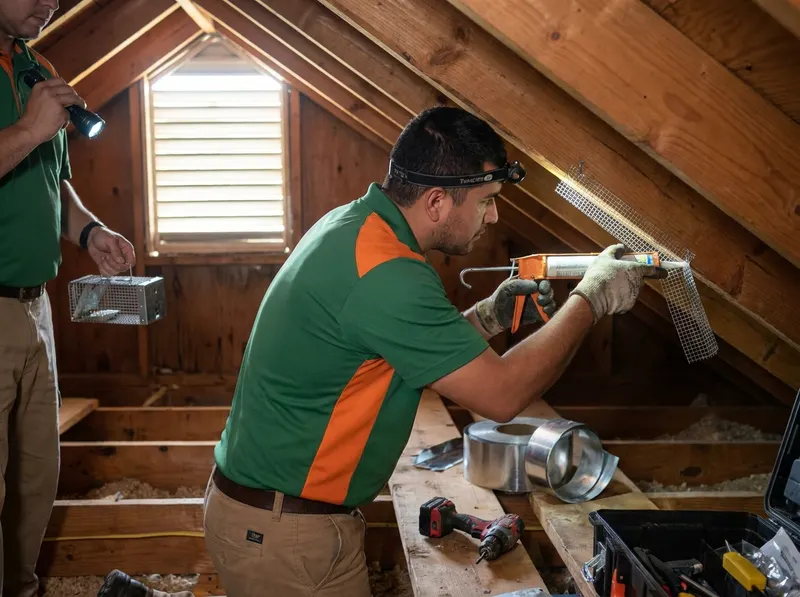
Gulf Coast humidity and mature tree canopies in established neighborhoods like Memorial, River Oaks, and The Heights create direct aerial pathways for roof rats to access vulnerable fascia boards, ridge vents, and soffits. Structural shifting common to Meyerland and Montrose foundation soils creates micro-gaps around plumbing stacks and air conditioning chases, permitting rodent entry into wall voids. Physical exclusion resolves these vulnerabilities permanently by sealing every gap larger than 1/4 inch using rust-resistant hardware cloth, metal flashing, and elastomeric sealants. Unlike temporary broadcast baiting, architectural exclusion prevents wildlife access while mechanical trapping inside the attic space swiftly removes current occupants without introducing chemical odors or secondary toxicity risks to neighborhood pets.
Effective rodent abatement balances mechanical capture with exterior remediation. Placing non-chemical snap traps along known attic runways eliminates rodents directly, avoiding the risk of rodents expiring inside inaccessible wall cavities. Homes along bayou corridors, such as properties near Buffalo Bayou Park or Hermann Park, experience elevated rodent pressure due to abundant water and riparian cover. Securing attic spaces protects blown-in fiberglass and cellulose insulation from compacting, urine saturation, and wire chewing, which represents a verified residential fire hazard under the National Fire Protection Association standards.
Homeowners weighing DIY hardware-store traps against professional exclusion frequently discover that unsealed entry points render interior trapping ineffective, as exterior populations continuously backfill cleared territory. While snap traps purchased individually cost less initially, professional exclusion addresses the primary building envelope. Technical remediation includes capping plumbing vent stacks, fitting custom covers over open weep holes, and screening attic gable vents according to guidelines maintained by the Texas A&M AgriLife Extension. This physical defense model ensures long-term home security across Oak Forest, Kingwood, and West University Place without locking homeowners into mandatory recurring monthly auto-pay contracts.
Executing complete attic remediation follows a standardized four-step mechanical sequence: First, a structural envelope review maps all attic breaches, thermal leaks, and rodent runs. Second, technician teams install galvanized steel screens over exterior utility penetrations and frieze boards in compliance with the U.S. Department of Housing and Urban Development housing quality standards. Third, technicians place targeted mechanical traps along attic joists, avoiding any open rodenticide dispersal. Fourth, technicians return to inspect catch counts, extract captured rodents, and verify that exterior seals remain intact across the structure.
Every job gets a firm, written price after a free on-site visit.
For standards, safe disposal, and service guidance on pest control services in Houston, TX, useful references include U.S. EPA, ENERGY STAR, U.S. Dept. of Energy, Consumer.gov, U.S. Census Bureau, and Google Maps. General consumer and small-business resources are available from USA.gov, Better Business Bureau, FTC Consumer Advice, U.S. Small Business Administration, and Ready.gov.
Tell us about your attic rodent exclusion and trapping job in Houston and we'll send a clear, written quote, usually the same day.
 ArborCrest Pest Control